


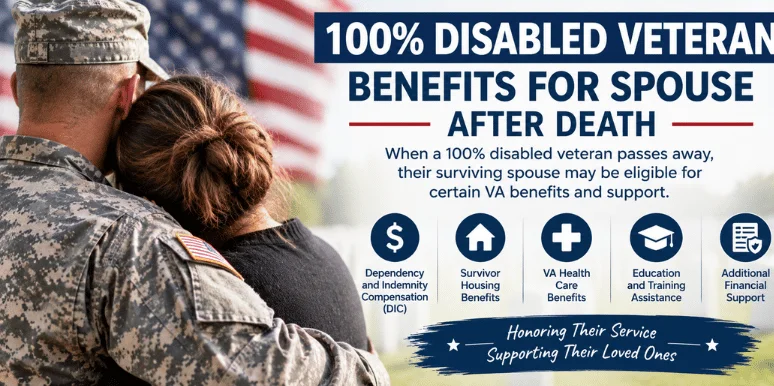
100 percent disabled veteran benefits for spouse after death: The surviving spouse does not automatically receive the same monthly payment. The spouse may qualify for separate benefits based on the cause of death, disability history, P&T status, and marital history.
For families researching 100 Percent Disabled Veteran Benefits After Death, Dependency and Indemnity Compensation (DIC) is usually the first benefit to consider. However, it is only one part of the available support.
A 100% disability rating is not always the same as a 100% permanent and total (P&T) rating. DIC may be available because of a service-connected death or a qualifying disability history. Benefits such as CHAMPVA and Chapter 35 education assistance may have additional P&T or cause-of-death requirements. Understanding that distinction can prevent surviving spouses from assuming they either automatically qualify for every benefit or qualify for none.
Direct answer: A surviving spouse does not automatically continue receiving the veteran’s 100% disability compensation after death. Instead, the spouse may qualify for DIC, CHAMPVA, Chapter 35 education benefits, Survivors Pension, VA home-loan eligibility, burial assistance, accrued benefits, Social Security survivor benefits, and other programs depending on the family’s circumstances.
Benefits a Surviving Spouse May Receive at a Glance
| Benefit | What It Provides | Key 2026 Information |
|---|---|---|
| VA DIC | Tax-free monthly survivor compensation | The base surviving-spouse rate is $1,699.36 per month for qualifying cases. |
| CHAMPVA | VA cost-sharing healthcare benefits | May apply when the veteran was P&T at death or died from a service-connected disability. |
| Chapter 35 DEA | Education and training payments | The full-time rate is $1,574 monthly through September 30, 2026, rising to $1,621 on October 1, 2026. |
| Survivors Pension | Needs-based monthly benefit | The 2026 net-worth limit is $163,699 through November 30, 2026. |
| VA Home Loan | Possible VA-backed loan eligibility | Certain qualifying surviving spouses can obtain a Certificate of Eligibility. |
| Burial Benefits | Burial, funeral, plot, and related assistance | Service-connected burial allowance can be up to $2,000. |
| Accrued Benefits | VA benefits owed but unpaid at death | The surviving spouse is first in the payment order and generally must apply within one year. |
The amounts above should be treated as current 2026 figures rather than permanent payment amounts because VA benefit rates can change with annual cost-of-living adjustments. Eligibility also varies significantly from one program to another, so receiving one survivor benefit does not necessarily establish eligibility for every other program. A spouse should review each benefit individually rather than relying only on the veteran’s former 100% rating.
100 Percent Disabled Veteran Benefits For Spouse After Death?
VA disability compensation is paid to the veteran. It does not automatically transfer to the surviving spouse after death. VA states that a veteran’s final month of compensation or pension may be payable to the surviving spouse. After that, ongoing survivor benefits come from separate programs, such as DIC. This distinction is important for families who relied on the veteran’s 100% disability payment. The surviving spouse’s DIC benefit may be much lower than the household’s previous monthly income. Families should review DIC and other survivor benefits as soon as possible. They should not assume that the veteran’s former disability payment will continue.
Dependency and Indemnity Compensation Is the Main VA Survivor Payment
Dependency and Indemnity Compensation is a tax-free VA monetary benefit for eligible surviving spouses, children, and parents. For a surviving spouse, eligibility may arise when the veteran died from a service-connected illness or injury, but the VA also recognizes certain cases in which the death itself was not service-connected. Those additional routes are especially important for spouses of veterans who held a total disability rating for many years before death.
When Can a Spouse Qualify for DIC?
A surviving spouse may potentially qualify when one of these veteran-related conditions applies.
- The veteran died from a service-connected illness or injury.
- The veteran’s death was not service-connected, but the veteran was entitled to compensation for a service-connected disability rated totally disabling for at least 10 years immediately before death.
- The veteran was totally disabled continuously from release from active duty and for at least five years immediately before death.
- The veteran was a former prisoner of war who had a qualifying total disability rating for at least one year before death and died after September 30, 1999.
The often-discussed “10-year rule” is therefore not the only way a spouse can receive DIC. If a veteran dies because of a service-connected condition, the spouse may qualify without showing that the veteran had been rated 100% for 10 years. The duration rules become particularly important when the veteran’s death was not caused by a service-connected illness or injury.
Marriage and Remarriage Rules Also Matter
VA also applies relationship requirements when deciding whether someone qualifies as a surviving spouse for DIC. VA also considers continuous cohabitation or whether a separation occurred without fault on the surviving spouse’s part.
Remarriage does not always permanently eliminate DIC eligibility under current rules. VA allows benefits to continue after certain qualifying remarriages. This includes some remarriages at age 55 or older under rules effective for marriages beginning January 5, 2021.
Because age and remarriage dates can affect eligibility, surviving spouses should ask VA to review their specific circumstances. They should not assume remarriage automatically ends their benefits.
How Much Is DIC for a Surviving Spouse in 2026?
According to the VA survivor DIC rate tables effective December 1, 2025, the 2026 base DIC rate is $1,699.36 per month for a qualifying surviving spouse of a veteran who died on or after January 1, 1993. VA identifies DIC payments as exempt. Additional amounts can increase the monthly payment when the survivor meets specific conditions.
| 2026 DIC Component | Monthly Amount |
|---|---|
| Base surviving-spouse rate | $1,699.36 |
| 8-year provision | +$360.85 |
| Aid and Attendance | +$421.00 |
| Housebound allowance | +$197.22 |
| Each qualifying child under 18 | +$421.00 |
| Transitional benefit with qualifying child under 18 | +$359.00 for the first two years |
The additional 8-year provision generally applies when the veteran was rated totally disabled, including through individual unemployability, for the eight full years immediately before death and the surviving spouse was married to the veteran throughout those same eight years. Aid and Attendance or housebound additions depend on the surviving spouse’s own qualifying circumstances, while dependent children can produce separate additions. These payments can make the actual DIC amount substantially higher than the basic $1,699.36 rate.
Why 100% Permanent and Total Status Matters
A veteran can have a 100% disability rating without necessarily having a permanent and total rating. VA describes P&T for CHAMPVA purposes as a service-connected disability rated 100% disabling that is not expected to improve. That distinction becomes especially important for benefits tied directly to P&T status rather than simply to the veteran having received compensation at the 100% rate.
A surviving spouse should therefore locate the veteran’s rating decision and determine whether VA specifically recognized the disability as permanent and total. The effective date of the total rating can also matter for DIC because some eligibility rules depend on how long the veteran was totally disabled. A temporary or non-P&T 100% rating should not automatically be treated as equivalent to P&T for programs such as CHAMPVA or DEA.
Can a Surviving Spouse Keep CHAMPVA After the Veteran Dies?
A surviving spouse may qualify for CHAMPVA when the veteran died from a service-connected disability or was rated permanently and totally disabled from a service-connected disability at the time of death. The surviving spouse must also not be eligible for TRICARE, because VA generally excludes people who can receive TRICARE from CHAMPVA eligibility. CHAMPVA is a cost-sharing healthcare program that can help cover qualifying medical services and supplies.
Remarriage rules for CHAMPVA differ from some other VA programs. A surviving spouse who remarries on or after age 55 can keep CHAMPVA, while remarriage before age 55 generally ends coverage on the date of remarriage. If that later marriage ends, the surviving spouse may become eligible for CHAMPVA again beginning on the first day of the following month.
Eligible survivors can apply online or use VA Form 10-10d, Application for CHAMPVA Benefits. Supporting documents can include evidence of marriage and, where relevant, Medicare or other health coverage information. A spouse should not assume that existing family enrollment automatically resolves every survivor-status issue after the veteran’s death.
Chapter 35: Education Benefits for a Surviving Spouse
The Survivors’ and Dependents’ Educational Assistance program, commonly called Chapter 35 or DEA, can provide education or job-training assistance to qualifying spouses and children. A spouse may qualify when the veteran was permanently and totally disabled because of a service-connected disability or died as a result of a service-connected disability, among other qualifying situations. VA specifically states that an eligible spouse can receive both DEA and DIC.
For education or training that began on or after August 1, 2018, DEA can generally provide up to 36 months of benefits. At colleges and universities, the full-time rate is $1,574 per month through September 30, 2026. Beginning October 1, 2026, the full-time monthly rate rises to $1,621 for the 2026–2027 benefit year.
Time limits also depend on when the event establishing DEA eligibility occurred. If the qualifying event happened before August 1, 2023, a spouse normally faces a defined eligibility period, often 10 years, with special rules for certain P&T and active-duty death situations. When the qualifying event occurs on or after August 1, 2023, VA states that there is no time limit for the spouse to use DEA benefits.
Survivors Pension May Help Lower-Income Spouses
VA Survivors Pension is different from DIC because it is a needs-based benefit for qualifying surviving spouses and unmarried dependent children of wartime veterans. The surviving spouse generally must not have remarried after the veteran’s death, the veteran must meet applicable wartime-service and discharge conditions, and household income and net worth must remain within VA limits. A former 100% disability rating is not itself the requirement for receiving a survivor’s pension.
From December 1, 2025, through November 30, 2026, the Survivors Pension net-worth limit is $163,699. For a surviving spouse with no dependent children, the basic 2026 Maximum Annual Pension Rate is $11,699, increasing to $14,298 for housebound status or $18,697 with Aid and Attendance. A qualifying spouse with one dependent child has a basic MAPR of $15,311, with higher limits when Housebound or Aid and Attendance rules apply.
VA generally does not pay DIC and Survivors Pension simultaneously simply by adding both monthly amounts together. A significant 2026 regulatory change, effective February 23, 2026, allows VA to pay the higher of the two benefits, generally DIC, without delaying the claim while it develops the lesser benefit.
VA Home Loan Benefits Can Extend to Some Surviving Spouses
Certain surviving spouses can qualify for a Certificate of Eligibility for a VA-backed home loan. VA lists qualifying circumstances that include veterans who died while in service or from a service-connected disability. The list also covers certain cases in which the veteran had been totally disabled before death, even when the disability was not the cause of death. Remarriage rules can affect eligibility, so the spouse’s individual circumstances still need to be checked.
Receiving a Certificate of Eligibility does not automatically guarantee mortgage approval. A private lender still evaluates factors such as income and credit and makes the lending decision. Surviving spouses who already receive DIC can generally use VA Form 26-1817 when seeking their COE, while those not receiving DIC may first need the survivor-benefits application process.
Burial and Memorial Benefits After a Veteran’s Death
VA burial assistance may help an eligible surviving spouse or another qualifying person with funeral, burial, transportation, or plot expenses. For a service-connected death occurring on or after September 11, 2001, the maximum service-connected burial allowance is $2,000. For an eligible non-service-connected death occurring on or after October 1, 2025, VA lists a $1,002 burial allowance plus $1,002 for a plot.
Additional memorial benefits can also be available separately from cash burial allowances. Depending on eligibility and burial arrangements, these can include national-cemetery burial services, government memorial items, and related benefits. Families should check the applicable service-connected or non-service-connected burial rules because the available reimbursement and filing requirements are not identical in every case.
Accrued Benefits May Cover Money VA Already Owed
Accrued benefits are amounts VA owed a beneficiary at the time of death but had not yet paid. When the deceased beneficiary is a veteran, VA places the surviving spouse first in the statutory payment order and can pay the eligible spouse the accrued amount in full. These payments are different from ongoing DIC because they concern benefits that had already become due before the veteran died.
A surviving spouse generally must apply for accrued benefits within one year of the beneficiary’s death, subject to a different rule for certain lump-sum accrued benefits. VA Form 21P-534EZ can be used by a surviving spouse or child to pursue accrued benefits along with DIC and Survivors Pension. Filing promptly is particularly important when the veteran had an unresolved benefit issue before death.
If the veteran died while a qualifying VA claim or appeal was still pending, an eligible survivor should also ask whether substitution is appropriate. VA Form 21P-0847 addresses substitution of a claimant, and the governing instructions provide one year after the claimant’s death for an eligible person to request substitution. This process can allow an eligible survivor to continue pursuing the deceased claimant’s unresolved matter rather than treating it as though no claim had existed.
Can a Spouse Receive Both DIC and Survivor Benefit Plan Payments?
The military Survivor Benefit Plan, or SBP, is separate from VA disability compensation and generally depends on qualifying military retired-pay coverage or another applicable SBP entitlement. Historically, DIC could reduce a surviving spouse’s SBP payment, creating what was known as the SBP-DIC offset. That offset has now been fully eliminated.
Since January 1, 2023, eligible surviving spouses can receive their full SBP payment and full DIC payment without the former offset. The first SBP payday reflecting full elimination was February 1, 2023. This does not mean every spouse of a 100% disabled veteran qualifies for SBP, because SBP eligibility has its own military retirement and coverage rules.
Social Security Survivor Benefits Are Separate From VA Benefits
A surviving spouse may also qualify for Social Security survivor benefits based on the deceased spouse’s Social Security record. SSA states that spouses may qualify beginning at age 60 or from ages 50 through 59 when they have a qualifying disability, while some spouses caring for the deceased worker’s child can qualify regardless of age. The monthly survivor benefit can range from 71.5% to 100% of the deceased spouse’s benefit depending on the age at which the survivor claims.
Social Security survivor benefits are a separate federal program and should not be confused with DIC. SSA also advises families to ask promptly about the $255 lump-sum death payment when a spouse dies. Because Social Security age, remarriage, work, and family rules differ from VA requirements, survivors should evaluate eligibility under both systems independently.
State Benefits May Add More Help
Federal VA programs are not the only possible benefits available after the death of a totally disabled veteran. Depending on the state, surviving spouses may encounter additional programs involving property taxes, education, vehicle benefits, or other veteran-related assistance. These programs are controlled by state law, so eligibility can differ substantially across the United States.
A benefit available to a surviving spouse in one state should therefore not be assumed to exist under the same conditions elsewhere. The safest approach is to contact the appropriate state veterans agency and local tax or benefits office after reviewing federal VA eligibility. Families that move between states should check the rules again because state-level survivor benefits may not transfer automatically.
How to Apply for VA Survivor Benefits
For most surviving spouses of veterans, VA Form 21P-534EZ is the central application to know. VA currently uses this form for DIC, Survivors Pension, accrued benefits, increased pension based on Aid and Attendance or housebound status, and certain other survivor claims. VA allows eligible spouses and children to begin the survivor-benefits application process online and submit supporting evidence with the claim.
A spouse preparing a claim should gather the records that show both the relationship to the veteran and the legal or medical basis for the requested benefit. Having the veteran’s disability decisions and effective dates available can be particularly important when eligibility depends on the duration of a total rating or on P&T status. Useful records commonly include the following.
- Veteran’s death certificate, including the reported cause of death.
- Marriage certificate or other applicable proof of marriage.
- Veteran’s DD214 or other separation records.
- VA rating decisions showing the 100% rating, P&T status, and effective dates.
- Medical records or opinions relevant to a service-connected cause of death.
- Information about dependent children.
- Household income, assets, and unreimbursed medical expenses for a pension claim.
- Banking and identifying information requested on the application.
Timing can also affect how much DIC is ultimately payable. When a veteran dies after service and VA receives the DIC claim within one year of death, the effective date can be the first day of the month in which the veteran died. If the claim arrives more than one year later, the effective date is generally the date VA receives it. Filing within the first year can therefore protect an earlier potential start date even when the surviving spouse is still assembling other documentation.
A surviving spouse does not have to handle a complicated claim without assistance. VA identifies accredited Veterans Service Organization representatives, accredited claims agents, and accredited attorneys as possible sources of claims help. Professional assistance can be particularly useful when the cause of death is disputed, the 100% rating began close to an eligibility cutoff, or the veteran had a pending claim when death occurred.
What If VA Denies the Surviving Spouse’s Claim?
A DIC or other survivor-benefit denial does not necessarily end the matter because VA provides multiple decision-review paths. Depending on the situation, a claimant can submit a Supplemental Claim with new and relevant evidence, request a Higher-Level Review without new evidence, or appeal to the Board of Veterans’ Appeals. The correct option depends on why VA denied the benefit and whether additional evidence is available.
For most benefits, Higher-Level Review and Board Appeal requests generally must be made within one year of the applicable decision. A Supplemental Claim may be filed later, although filing within one year can be important for preserving an effective date. Survivors should read the actual VA decision letter because it explains the available review rights and relevant deadline for that decision. Knowing what a benefits appeal actually involves makes that letter far easier to act on within the deadline.
Frequently Asked Questions
Does a Wife Get Her Husband’s 100% VA Disability After He Dies?
No, a surviving wife does not simply take over her husband’s regular 100% VA disability compensation after his death. She may instead qualify for DIC and potentially other programs such as CHAMPVA, DEA, Survivors Pension, accrued benefits, or VA home-loan eligibility. The exact benefits depend on factors including the cause of death, rating history, P&T status, marriage history, income, and other program-specific rules.
How Long Must a Veteran Be 100% Disabled for a Spouse to Get DIC?
There is no single rule requiring every veteran to have been 100% disabled for the same length of time. When death is service-connected, one important route requires a total disability rating for at least 10 years immediately before death. Other routes cover continuous total disability from discharge for at least five years or certain former POW cases involving one year. A spouse may also qualify when the veteran died from a service-connected condition without satisfying the 10-year total-disability route.
Does the Veteran Have to Be 100% P&T for the Spouse to Receive DIC?
No, 100% permanent and total status is not universally required for DIC. DIC can be based on the veteran dying from a service-connected illness or injury or on one of VA’s qualifying total-disability duration rules. P&T status is especially important when considering separate survivor benefits such as CHAMPVA and Chapter 35 DEA.
Can a Surviving Spouse Receive DIC and Social Security at the Same Time?
A surviving spouse may potentially qualify for both because VA DIC and Social Security survivor benefits are separate federal programs with different eligibility rules. Social Security survivor eligibility depends on the deceased worker’s record and factors such as the surviving spouse’s age, disability status, caregiving circumstances, and remarriage history. Survivors should apply or inquire under both systems rather than assuming approval under one automatically determines the other.
Can a Surviving Spouse Receive Both DIC and SBP?
Yes, an eligible surviving spouse can now receive full DIC and full Survivor Benefit Plan payments at the same time. The former SBP-DIC offset was eliminated effective January 1, 2023, with the first fully adjusted SBP payday occurring February 1, 2023. The spouse must still independently qualify for SBP because a veteran’s 100% VA disability rating does not by itself create SBP coverage.
Can a Surviving Spouse Continue CHAMPVA After the Veteran Dies?
Potentially, yes, because CHAMPVA specifically covers certain surviving spouses. A spouse may qualify when the veteran died from a service-connected disability or was rated permanently and totally disabled from a service-connected disability when death occurred, provided the survivor is not eligible for TRICARE. Remarriage can affect coverage, although VA allows a surviving spouse who remarries at age 55 or older to keep CHAMPVA.
Bottom Line
The most important fact about 100 percent disabled veteran benefits for the spouse after death is that the veteran’s regular disability compensation does not simply become the surviving spouse’s payment. DIC is often the central monthly survivor benefit, but CHAMPVA, Chapter 35 DEA, Survivors Pension, VA-backed home loan eligibility, burial assistance, accrued benefits, SBP, Social Security, and state programs may also be relevant. The spouse should verify the veteran’s rating effective date, P&T status, cause of death, and marriage history before deciding which benefits apply.
Starting with VA Form 21P-534EZ can help a surviving spouse pursue several major VA survivor benefits through one application process. Filing promptly is particularly valuable because a DIC claim received within one year of a post-service death can potentially receive an effective date beginning with the month of death. Families facing unusual rating histories or a disputed service connection should consider assistance from a VA-accredited representative rather than relying solely on the fact that the veteran had a 100% rating.
