


Order wings, and you get pieces, not whole wings. That one detail decides whether your count is right or off by half. Most charts answer a question nobody asks at a table. This guide gives you the calories in a chicken wing per piece, per order, and per sauce.
A plain fried piece from a wing joint runs about 72 calories before anything touches it. Baked at home, closer to 55. Six pieces land near 430 calories, ten near 720, and twenty near 1,440. Sauce adds 5 to 160 on top of that, and a single tub of ranch can add another 320.
One wing is three pieces, and only two get served
A whole wing has three parts joined end to end. The drumette looks like a tiny drumstick and carries one bone. Next comes the flat, also called the wingette, with two thin bones and more skin than meat. Last is the tip, a pointed end that is mostly cartilage.
Kitchens cut the wing at both joints. Tips go to the stockpot or the bin. So a menu that promises 10 wings hands you 10 segments, which came off roughly five whole wings.
- Drumette: one bone, the meatiest of the three pieces
- Flat: two bones, less meat, more skin per bite
- Tip: skin and cartilage, roughly 10 to 15 calories, almost never on your plate
Calories in a chicken wing, piece by piece

Start with the meat itself. According to USDA FoodData Central, roasted wing meat with the skin on comes to 216 calories per 3 oz in the 2019 Standard Reference Legacy record. That is roughly 72 calories per ounce of what you actually chew. One segment gives you somewhere near an ounce of edible meat and skin. Everything after that is cooking method and coating.
| Piece | How it is cooked | Calories each |
|---|---|---|
| Drumette | Baked or roasted, plain | about 60 |
| Flat | Baked or roasted, plain | about 55 |
| Drumette or flat | Deep fried, no coating | 70 to 80 |
| Drumette or flat | Battered or breaded | 90 to 120 |
| Tip | Any | 10 to 15 |
Drumettes beat flats by about five calories a piece. The gap is small because the flat trades meat for skin, and skin is where the fat sits. Protein tracks the other way. A plain segment carries about a quarter ounce of it, so ten of them rival a scoop from any of the healthiest protein powder picks on the shelf. Wings are a decent protein source that happens to arrive fried.
Key takeaways
- A menu “wing” means one segment, so 10 wings is about five whole wings.
- Plain fried segments sit near 72 calories each. Baked ones sit near 55.
- Six-, ten-, and twenty-piece orders run roughly 430, 720, and 1,440 calories bare.
- Sauce ranges from 5 calories for a dry rub to 160 for a buttery lemon pepper.
- Dip is the biggest hidden line on the ticket, up to 320 calories a tub.
What a 6, 10, or 20-piece order really adds up to
Chain nutrition guides make this easy to check. Buffalo Wild Wings lists its bone-in wings before sauce, which is exactly the baseline you want. The per-piece column below is simple division, and it barely moves as the order grows.
| Order | Calories | Per piece |
|---|---|---|
| Buffalo Wild Wings, 6 bone-in, no sauce | 430 | 72 |
| Buffalo Wild Wings, 10 bone-in, no sauce | 720 | 72 |
| Buffalo Wild Wings, 20 bone-in, no sauce | 1,440 | 72 |
| Wingstop classic wings, Original Hot | 90 each | 90 |
| Wingstop classic wings, Lemon Pepper | 120 each | 120 |
Boneless wings are a different animal. They are breaded chunks of breast meat, so the coating does most of the damage even though the meat itself is leaner than a wing. On a like-for-like order, bone-in usually ends up the smaller number.
Sauce is the number nobody counts
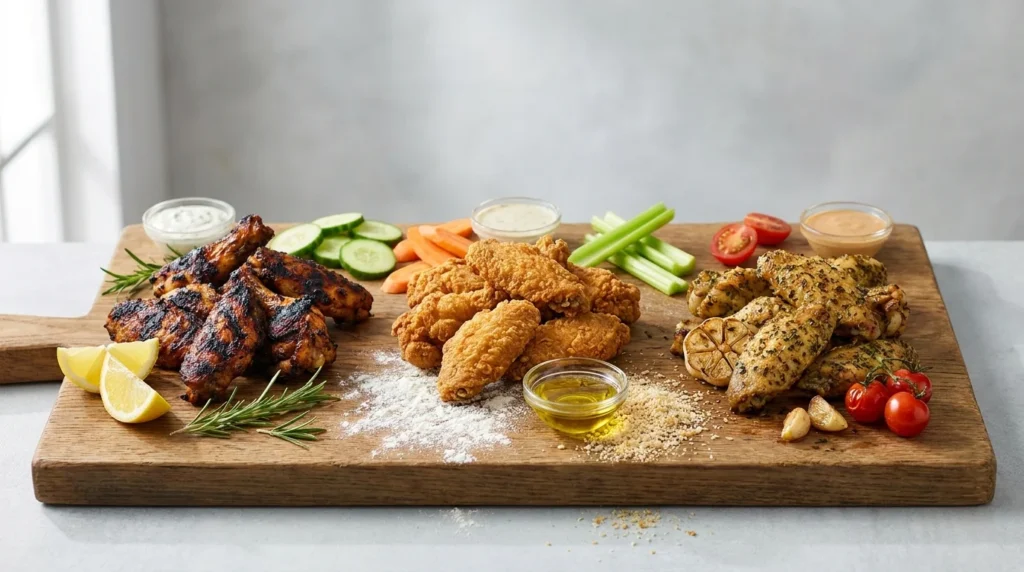
People tally the wings and forget the coating. A dry rub adds almost nothing. Sweet glazes are sugar- and butter-based sauces, so both land harder than the shaker of spice ever will. Here is what Buffalo Wild Wings adds to a six-piece bone-in order, by flavor.
| Sauce or rub, on 6 wings | Calories added |
|---|---|
| Desert Heat dry rub | 5 |
| Medium (classic buffalo) | 30 |
| Hot | 45 |
| Sweet BBQ | 50 |
| Honey BBQ | 70 |
| Mango Habanero | 70 |
| Asian Zing | 90 |
| Parmesan Garlic | 130 |
| Lemon Pepper | 160 |
At home the pattern holds. Bottled honey garlic wing sauce runs 25 to 30 calories a tablespoon. A standard barbecue sauce such as Sweet Baby Ray’s Original is 70 calories per 2 tbsp. Straight hot sauce is close to zero. The melted butter most cooks whisk into it adds about 100 calories per tablespoon, and that is why homemade buffalo wings often beat the restaurant version.
Ranch and blue cheese: the quiet 320
Dip is where a careful order falls apart. A side of dressing can carry more calories than four wings, and nobody counts it because it arrives in a small cup.
- Buffalo Wild Wings ranch, 2 fl oz side: 320 calories
- Buffalo Wild Wings bleu cheese, 2 fl oz side: 280 calories
- Hidden Valley Original Ranch at home, 2 tbsp: 130 calories
Ask for the dressing on the side and dunk only the tip of each piece. That one habit saves more than switching from fried to baked ever will.
Fried, baked or air-fried
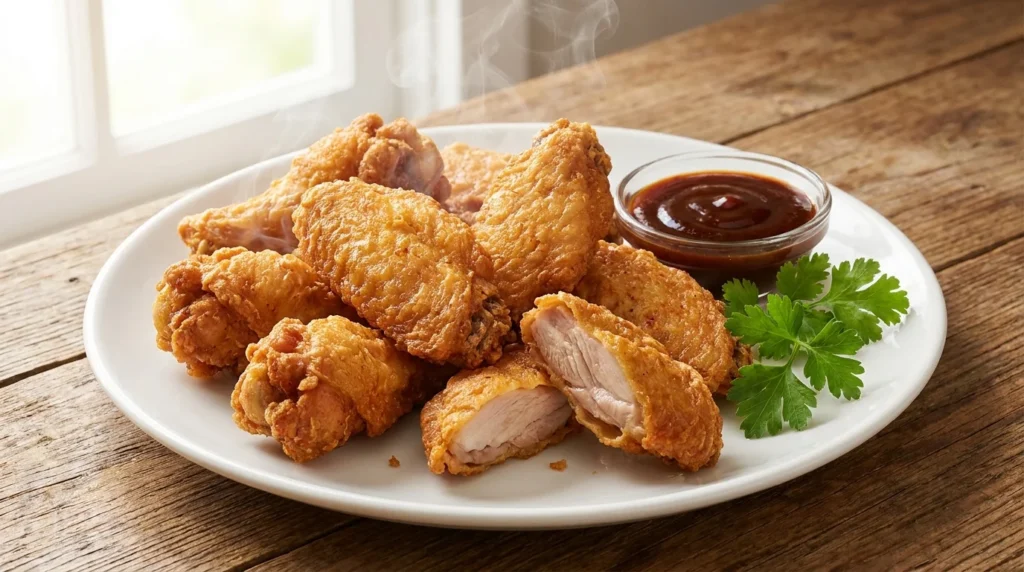
Cooking method moves the number more than flavor does. USDA figures put one whole wing fried in batter at 159 calories, against 103 calories for the same wing dredged in flour. Skip the coating and bake, and you land back near the plain meat figure.
Air fryers land between baked and deep fried. You keep the crisp skin without adding a bath of oil, and the skin itself still carries most of the fat. Pulling the skin off drops a segment to roughly 35 calories, though few people order wings to do that.
The rest of the plate matters too. Celery and carrots add almost nothing and, along with the best foods for strong teeth, they make the meal less punishing. Fries and a dessert are the real problem. One bakery cookie the size of the ones that built the Crumbl cookie franchise can outweigh your entire six-piece order.
Do the math at the table
You do not need an app. Four numbers cover almost every order, and this is the shortcut I use for calories in a chicken wing on a menu I have never seen.
- Count pieces, not wings. Ten listed means ten segments.
- Multiply by 75 for fried, 55 for baked, 110 for breaded.
- Add 10 for a rub, 50 for a hot sauce, 120 for a sweet or cheesy one.
- Add 300 if you finish the dip. Halve it if you dunk lightly.
The number to remember
Seventy-two. That is a plain fried segment, and every other figure on this page is that number adjusted for coating, sauce, and dip. Multiply, add, and you will be within about fifty calories of the truth.
Order the rub instead of the glaze, ask for dip on the side, and a wing night stops being a write-off. The wings were never the problem.
Frequently asked questions
Slightly. A drumette carries more meat, so it runs about five calories above a flat of the same size. Flats carry proportionally more skin, which narrows the gap.
Ten bone-in wings with no sauce are about 720 calories at Buffalo Wild Wings. Add sauce and a dip and 1,100 is realistic. Breaded or boneless versions run higher again.
A single segment gives you about a quarter ounce of protein. Ten pieces land near 3 oz of it, which is a genuine reason wings show up in high-protein meal plans.
Yes, by roughly a quarter. Baking skips the oil the batter would soak up. The saving shrinks fast if you brush on a sugary glaze afterward.
Sharply. A dry rub adds almost nothing, while a buttery lemon pepper coating adds 160 calories across a six-piece order. Sweet glazes sit in the middle, near 50 to 90.
